Cantor Arts Center
328 Lomita Drive at Museum Way
Stanford, CA 94305-5060
Phone: 650-723-4177

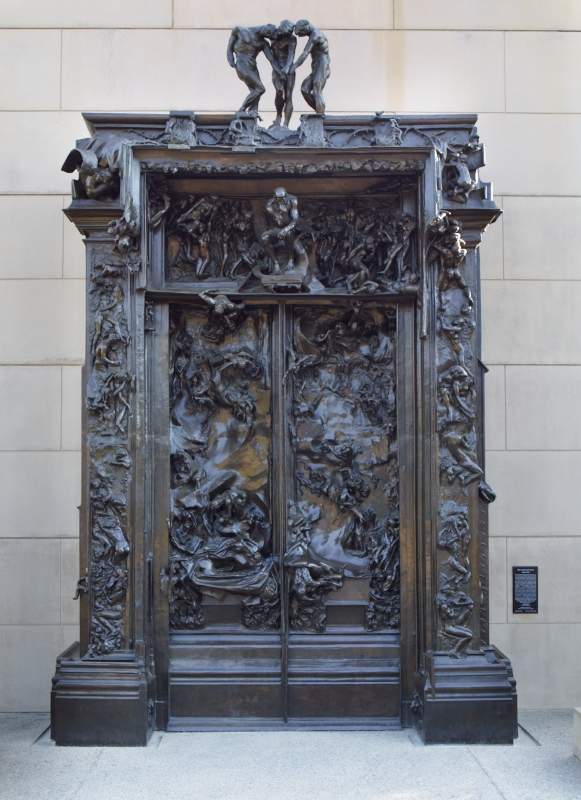
Auguste Rodin (French, 1840-1917), The Gates of Hell (1880-c. 1900, cast in 1981). Bronze. Cantor Arts Center, Stanford University. Gift of the B. Gerald Cantor Collection, 1985.86.
Since it officially opened in 1985, The B. Gerald Cantor Sculpture Garden has been open to the public twenty-four hours a day, three hundred and sixty-five days a year. Within a single acre lushly landscaped with cypress trees and gravel paths modeled after the Bagatelle Gardens in Paris, it comprises twenty monumental bronzes that include many of Rodin’s most famous sculptures including The Walking Man, two heads of the Burghers of Calais (the life size versions of which can be seen in Memorial Court in front of the Main Quad), Adam, Eve, and The Three Shades. Visually anchoring the garden at its eastern end is The Gates of Hell, a massive work cast by the Coubertin Foundry in 1981 using the lost-wax process favored by Rodin.
Click on the button below to explore the works of art that are part of The B. Gerald Cantor Rodin Sculpture Garden. You can find more details such as dimensions, materials, provenance, and images. Explore our collections page and gain a better understanding of the breadth of our sculpture garden.
With dust, UV light radiation and acid rain to contend with, it's difficult to keep outdoor works of art in their original, intended condition. In this video you can observe the museum's efforts to help fend off corrosion. In this 2015 video, conservators first wash the sculptures, then apply a layer of wax to act as a buffer between the patina and outside elements.